
World models: the AI that learns how the world works
$4 billion chased world models in a year, yet the field's own tests show the prettiest ones understand the world the least. What's real, what's hype, and where your team can pilot one now.

Hello everyone,
An airline pilot can survive her thousandth engine fire without ever leaving the ground… That is indeed the whole point of a flight simulator: a safe, cheap copy of reality where failure costs nothing and experience is unlimited. In this article we are going to deep dive into world models, the branch of AI that tries to give machines exactly that, an internal simulator of how the world works. By the end, you will know what a world model actually is (and is not), why a Turing Award winner walked away from Meta while $1 billion walked toward him, where the research honestly stands in 2026, and what your team could realistically pilot this quarter. Let’s go.
The money arrived before the definition
In about twelve months, world models went from a research niche to the hottest term sheet in AI. Yann LeCun, Turing Award winner and Meta’s Chief AI Scientist for over a decade, left to found AMI Labs, which raised a $1.03 billion founding round in March 2026 at a $3.5 billion pre-money valuation, backed by Bezos Expeditions, Nvidia, Eric Schmidt and Mark Cuban. Fei-Fei Li, the Stanford professor best known for creating ImageNet (the dataset that kicked off the deep-learning era, which earned her the nickname “godmother of AI”), founded World Labs around one thesis: that spatial intelligence, the ability to understand and reason about the 3D world, is the next frontier after language. World Labs shipped Marble, the first commercial world-model product, in November 2025, and was soon reported in talks to raise at a $5 billion valuation.
The robotics wing of the movement is even bigger: Skild AI raised $1.4 billion (valued over $14 billion), Physical Intelligence $600 million, Odyssey $310 million, Decart $300 million. Add it up and roughly $4 billion flowed into world-model companies in about a year.
And yet, ask five of these companies what a world model is and you will get five different answers: an interactive video game, a 3D asset generator, a robot brain, a driving simulator, a new path to human-level AI. The sharpest comment on this came from LeCun himself, relayed by his own CEO: “My prediction is that ‘world models’ will be the next buzzword. In six months, every company will call itself a world model to raise funding.” He said this while raising a billion dollars for a world-model lab. So let’s do what the term sheets have not: define the thing.
First, the baseline: next word vs next state
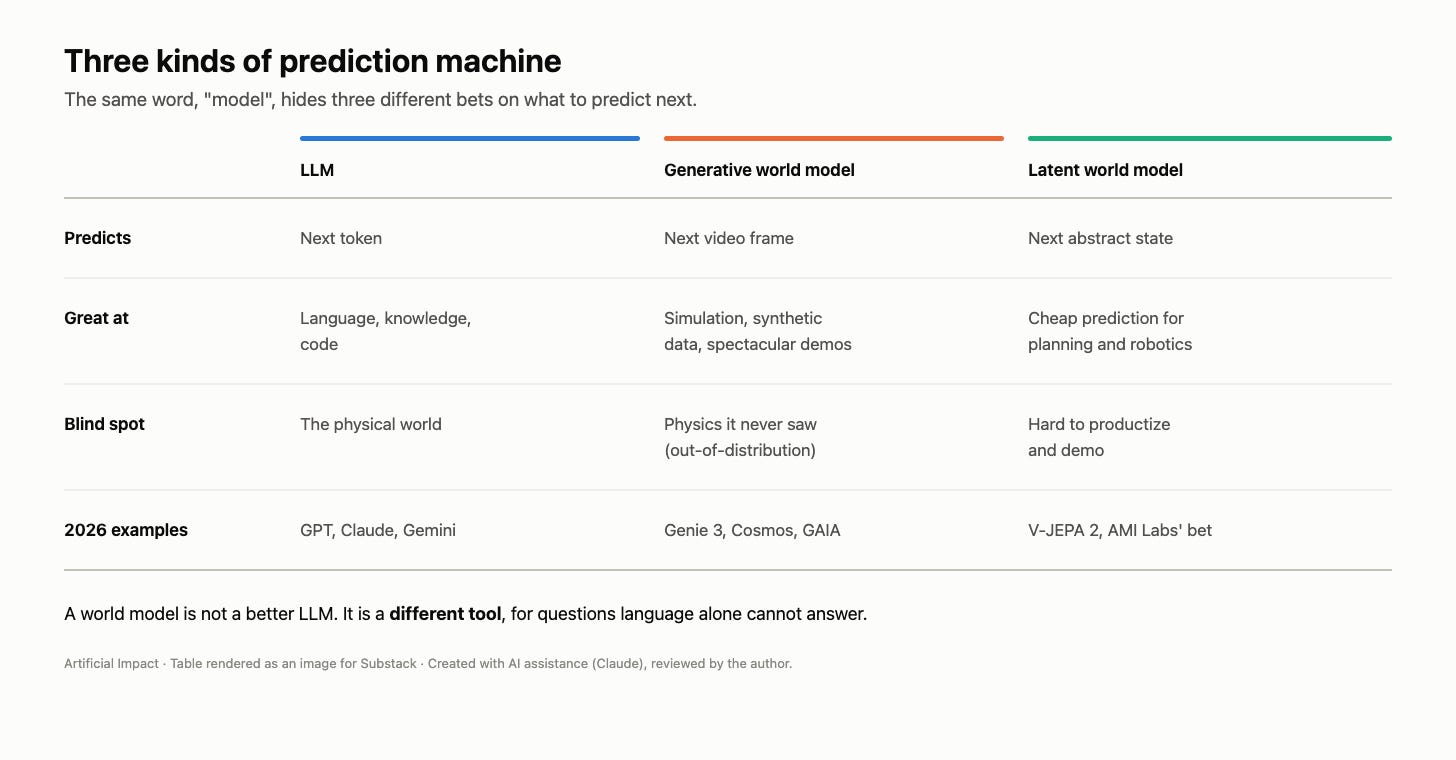
You already know what an LLM does: it predicts the next token in a sequence of text. It has, in effect, read everything ever written. A world model makes a different prediction: given the state of the world and an action, what happens next? Not the next word. The next state of the world.
Think of two chess players. The first has memorized every recorded game in history; she is brilliant for as long as the board stays inside the book. The second simulates moves in her head: “if I take the knight, then the pawn structure collapses, then...”. The first player recalls. The second one plans in imagination. That, in one image, is the difference between a pattern model and a world model.
The idea is older than the hype. In 2018, David Ha and Jürgen Schmidhuber published a paper literally titled “World Models”, where a small agent learned a compressed model of its environment and then trained inside its own dream of it. The line matured through DeepMind’s Dreamer series: in April 2025, DreamerV3 was published in Nature as the first agent to find diamonds in Minecraft with zero human data, purely by imagining futures inside its learned model and picking the ones that worked.
ℹ️ Small glossary
World model = an AI system that learns an internal, predictive model of an environment (objects, physics, cause and effect) so it can simulate outcomes before acting.
Generative / pixel-space model = predicts the future as actual video frames (photorealistic, heavy).
Latent model = predicts the future in a compressed, abstract representation (no pixels, lighter, harder to show in a demo).
Out-of-distribution (OOD) = situations unlike anything in the training data; the honest test of understanding.
Zero-shot = performing a task with no task-specific training.
The twist: the prettiest worlds may understand the least
Here is the uncomfortable finding that should calibrate every buying decision in this space. Two rigorous studies took the most photorealistic video generators (Sora, Runway, Pika, Lumiere, Stable Video Diffusion) and tested whether they had learned actual physics.
Google DeepMind’s Physics-IQ benchmark tested fluid dynamics, optics, solid mechanics, magnetism and thermodynamics, and concluded in five words: “visual realism does not imply physical understanding.” ByteDance’s phyworld study went further: video generation “fails to learn physical laws from video data, even with scaling.” The models do case-based mimicry of their nearest training examples; on out-of-distribution scenarios, errors jump by an order of magnitude. Meta’s own IntPhys 2 benchmark makes the gap human-legible. The test is disarmingly simple: show short videos in which one object quietly does something impossible (slides through a wall, vanishes behind a box, floats away) and ask, “possible or impossible?”. Humans get it right 85 to 95% of the time. Current models score at or near chance, roughly a coin flip: they cannot reliably tell physics from magic.
To be fair, the counter-evidence is real too. Genie 3’s minutes-long world consistency was not hard-coded, it emerged. And Waymo (a subsidiary of Alphabet working on self-driving technologies) shipping a production simulation tool on top of Genie 3 proves that pixel-space models create real value even without deep physical understanding. The honest position: usefulness and understanding are different axes. The real fault line in this field is not “LLMs vs world models”. It is generating convincing pixels vs learning causal structure.
A kitchen version of that fault line: a cook who has memorized ten thousand recipes reproduces them flawlessly, until the kitchen changes. New altitude, different butter, and the sauce splits. A chef who understands why emulsions hold adapts on the spot. Photorealistic video models are, today, mostly the first cook. The bet of the latent camp is that you can train the second one.
So... how does a world model actually work?
Two rival architectures are competing to become the standard. They share a goal (predict the future, then plan against the prediction) and disagree on everything else.
Lane 1: generative, in pixel space
Models like DeepMind’s Genie 3 (August 2025) and NVIDIA’s Cosmos predict the future as literal video frames. Type a prompt, get a navigable 720p world at 24 frames per second, consistent for a few minutes, with about one minute of visual memory. It is spectacular, easy to demo, and computationally very heavy: you are paying to render every raindrop, including the ones that do not matter for the decision you need to make.
Lane 2: latent, in abstract space
Meta’s V-JEPA 2 (June 2025) predicts in a compressed representation space instead. No pixels; the model predicts the summary of the future, not the picture of it. The numbers are the story here: a 1.2 billion parameter model, trained on over 1 million hours of video plus only 62 hours of robot data, achieved 65 to 80% zero-shot success picking and placing objects it had never seen, in environments it had never visited. LeCun argues only this lane scales to real understanding, because predicting every pixel wastes capacity on unpredictable detail.
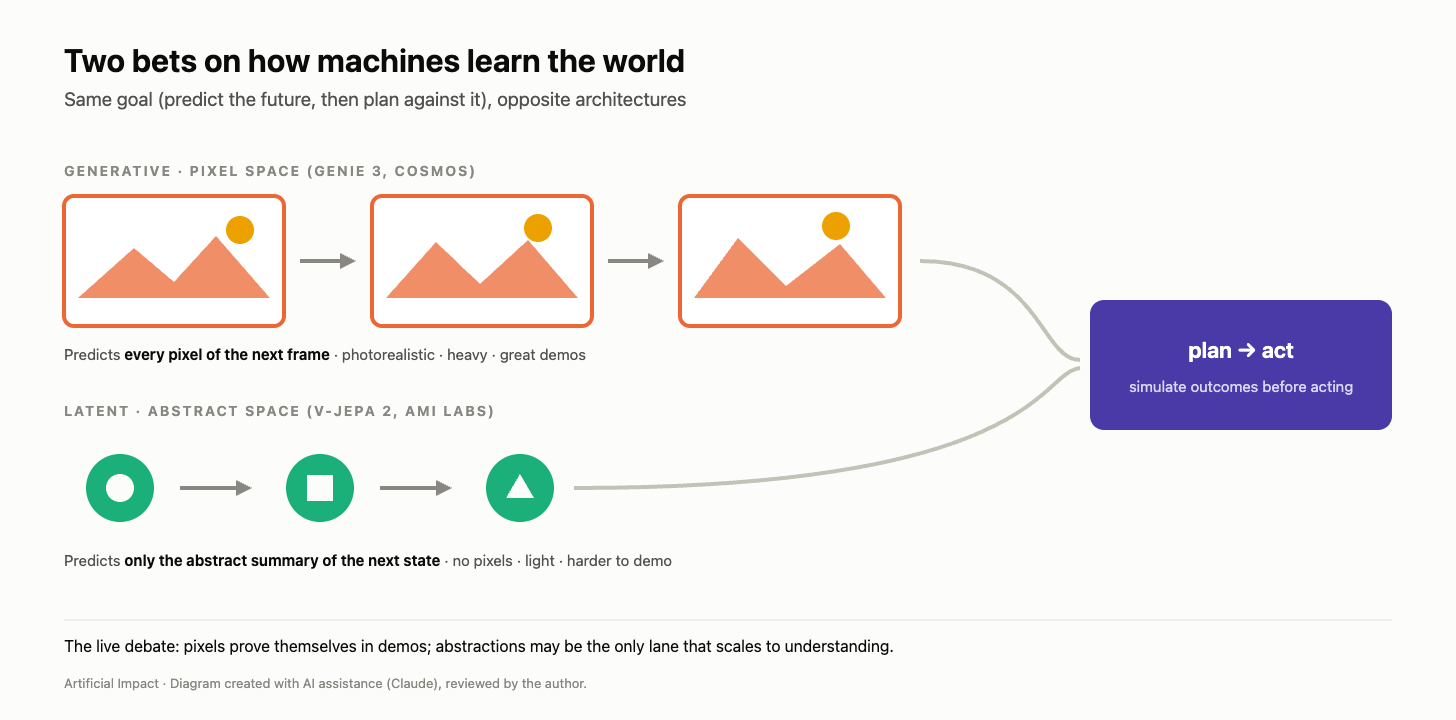
Here is the same contrast as a tiny worked example:
What can you actually do with this in 2026?
Back to the flight simulator, because it carries the whole business case. Airlines do not train pilots on engine fires by setting engines on fire; they simulate thousands of failures, safely and cheaply. World models are flight simulators for your machines and processes. With that lens, the landscape sorts neatly into three shelves.
Usable now (pilot this quarter)
Simulation for autonomy and safety testing. Waymo’s World Model (February 2026, built on Genie 3) simulates tornadoes and reckless drivers its roughly 200 million real autonomous miles never captured ⇒ rare events become training data. Wayve, the UK autonomous-driving startup backed by SoftBank and Nvidia, does the same for assisted driving with its GAIA world models. If you run vehicles, drones or warehouse robots, this pattern is procurable today, notably via NVIDIA Cosmos, which is open and on Hugging Face.
Synthetic training data. Cosmos Transfer turns cheap structured inputs (depth maps, lidar, segmentation) into photorealistic training video ⇒ a direct attack on the data bottleneck of any computer-vision team. This is the most concrete near-term ROI in the whole space.
3D content generation. Marble turns text or photos into persistent, exportable 3D environments for game backgrounds, VR walkthroughs, or real-estate visualization, from free to $95 per month. Not a research preview: a product you can expense.
Watch closely (2 to 3 years)
Robot foundation models (Physical Intelligence, Skild, NVIDIA GR00T). V-JEPA 2’s zero-shot results say the curve is steep, but 65 to 80% success is remarkable for research and unacceptable for your warehouse. The success rates need to roughly double.
Interactive world engines (Genie-class, Odyssey, Decart’s Oasis) as training gyms for embodied agents, and as a new media format.
AMI Labs’ healthcare-first bet with Nabla: a signal that world-model reasoning may reach non-physical domains like decision support sooner than robotics matures.
Don’t bet on yet
Any vendor claiming their video generator “understands physics” ⇒ ask for out-of-distribution evaluations and cite Physics-IQ and phyworld when they blink.
General-purpose “world model APIs” as LLM replacements. No such product exists, and even LeCun frames human-level results as a decade-scale bet.
Replacing certified physics simulation (FEA, CFD, safety cases) with learned models where correctness is regulatory. Beautiful is not the same as correct, and your auditor knows it.
Is this a big thing?
Yes, with calibration. The recap:
World models predict the next state of the world, not the next word. That single difference is what planning, robotics and honest simulation need ⇒ it is a different tool, not a better LLM.
The field’s own tests show pretty is not the same as true. Frontier video models score near chance on impossible-physics benchmarks that humans pass at 85 to 95% ⇒ treat photorealism as a demo, not as evidence.
The architecture war is genuinely unsettled. Pixel-space (Genie, Cosmos) versus latent (JEPA, AMI Labs) is a live scientific debate with a billion dollars on each side ⇒ do not marry either lane yet.
Production value already exists at the edges. Waymo, Wayve and Cosmos prove simulation and synthetic data work at industrial scale today ⇒ that is where your first pilot belongs.
The vocabulary is inflating faster than the capability. When every pitch deck says “world model”, the definitions in this article are your due-diligence checklist.
The one-line takeaway: treat world models in 2026 the way you should have treated LLMs in 2020. Wrong to build your roadmap on, wrong to ignore, and exactly right to pilot where failure is cheap and simulation is valuable.
As Fei-Fei Li, the ImageNet creator whose World Labs we met earlier, puts it: “our dreams of truly intelligent machines will not be complete without spatial intelligence.” So, a question to leave you with: where in your operation is failure expensive and simulation cheap? That is where a world model belongs first.
And you?
Is your team experimenting with simulation or synthetic data, or still watching from the sidelines?
Sources
Research
Ha & Schmidhuber (2018). World Models. https://arxiv.org/abs/1803.10122
Hafner et al., Nature (Apr 2025). Mastering diverse control tasks through world models (DreamerV3). https://www.nature.com/articles/s41586-025-08744-2
Google DeepMind (2025). Do generative video models understand physical principles? (Physics-IQ). https://arxiv.org/abs/2501.09038
ByteDance (ICML 2025). How Far is Video Generation from World Model: A Physical Law Perspective.
Labs & official announcements
Meta AI (Jun 2025). Introducing V-JEPA 2. https://ai.meta.com/blog/v-jepa-2-world-model-benchmarks/
Google DeepMind (Aug 2025). Genie 3: a new frontier for world models. https://deepmind.google/blog/genie-3-a-new-frontier-for-world-models/
NVIDIA (2025-2026). Cosmos world foundation models. https://nvidianews.nvidia.com/news/nvidia-announces-major-release-of-cosmos-world-foundation-models-and-physical-ai-data-tools
Waymo (Feb 2026). The Waymo World Model. https://waymo.com/blog/2026/02/the-waymo-world-model-a-new-frontier-for-autonomous-driving-simulation/
News
TechCrunch (Mar 2026). Yann LeCun’s AMI Labs raises $1.03 billion. https://techcrunch.com/2026/03/09/yann-lecuns-ami-labs-raises-1-03-billion-to-build-world-models/
TechCrunch (Nov 2025). World Labs launches Marble. https://techcrunch.com/2025/11/12/fei-fei-lis-world-labs-speeds-up-the-world-model-race-with-marble-its-first-commercial-product/